
Why Tunnels Are Changing the Fire-Testing Conversation
Fire testing plays a critical role in protecting life safety as new structures are designed and built. As construction methods evolve and new materials are introduced, testing standards must also adapt to ensure consistent, reliable performance evaluation.
Recent discussions within ASTM’s Committee E05 on Fire Standards highlight how emerging projects, such as Universal Passenger Vehicle (UPV) tunnels, are reshaping the fire-testing landscape.
These underground systems, such as light rail lines and the Las Vegas Loop, operate in confined spaces. Their conditions differ sharply from traditional buildings, especially around smoke movement, evacuation, and fire growth.
The increased adoption of electric vehicles further elevates the importance of understanding fire and smoke behavior in these spaces, making material performance a key consideration in tunnel safety planning.
Fire Safety Challenges in UPV & Transit Tunnels
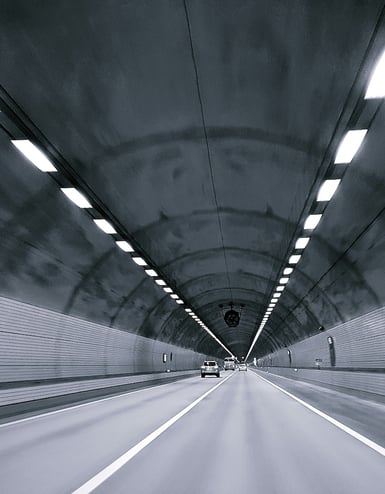
UPV and transit tunnels introduce a unique set of fire safety challenges driven by their length, enclosure, and operational use. In the event of a fire, smoke control and occupant egress become significantly more complex than in above-ground structures.
Electric vehicles, which currently rely on lithium-ion batteries, introduce additional considerations related to fire intensity and duration. Combined with long tunnel spans and restricted access for emergency response, these factors increase reliance on passive fire protection measures.
Lithium-ion battery fires can burn hotter and longer than conventional vehicle fires, and they can reignite after they appear to be out. In a sealed tunnel, that sustained heat places heavy demand on wall linings and structural protection.
Materials such as tunnel wall linings, insulation systems, fire-retardant coatings, and structural protection layers become a primary line of defense.
Smoke behavior matters just as much. In a long, enclosed tunnel, smoke can travel far from its source and cut visibility along the main escape route. That means the flame spread and smoke behavior of exposed materials directly affect how safely people can get out.
However, without standardized testing approaches that reflect tunnel-specific conditions, it can be difficult to consistently evaluate and compare material performance.
Where ASTM E84 Fits in Tunnel Material Evaluation
ASTM E84, commonly referred to as the Steiner Tunnel Test, evaluates the surface burning characteristics of materials by measuring Flame Spread Index (FSI) and Smoke Development Index (SDI).
While ASTM E84 is not a fire-resistance test, and it does not replicate a tunnel fire. Still, it remains a widely recognized screening tool for the fire and smoke behavior of exposed materials. For tunnel applications, ASTM E84 is increasingly used to evaluate:
- Tunnel wall panels
- Fire-retardant coatings
- Polymer-based materials
- Insulation systems
- Transportation-related components
Given the distinct hazards in tunnel environments, ASTM E84 data must be interpreted carefully. In many cases, it should be paired with additional fire testing to build a complete performance profile.
Building a Complete Tunnel Fire Profile Beyond ASTM E84
Because ASTM E84 only screens surface burning, it rarely tells the full story for a tunnel or transit project. Most underground applications call for a combination of tests that together show how a material behaves under real fire conditions.
Depending on the material and the governing code, a complete evaluation may draw on several complementary methods:
- ASTM E119, which measures how long an assembly or lining resists fire and continues to perform
- ASTM E1354, known as the Cone Calorimeter, which quantifies heat release rate, a key measure for high-energy fire loads such as electric vehicles
- NFPA 130, the Standard for Fixed Guideway Transit and Passenger Rail Systems, which sets material requirements specific to transit environments
Read together, these results give transit authorities, authorities having jurisdiction (AHJs), and design teams a clearer view of how a material will perform, not just how its surface burns.
How We Support Tunnel & Transit Projects With Advanced Fire Testing
NGC Testing Services supports large-scale tunnel and transit fire testing, with specialized facilities designed to evaluate full wall assemblies, tunnel lining systems, and oversized transportation components.
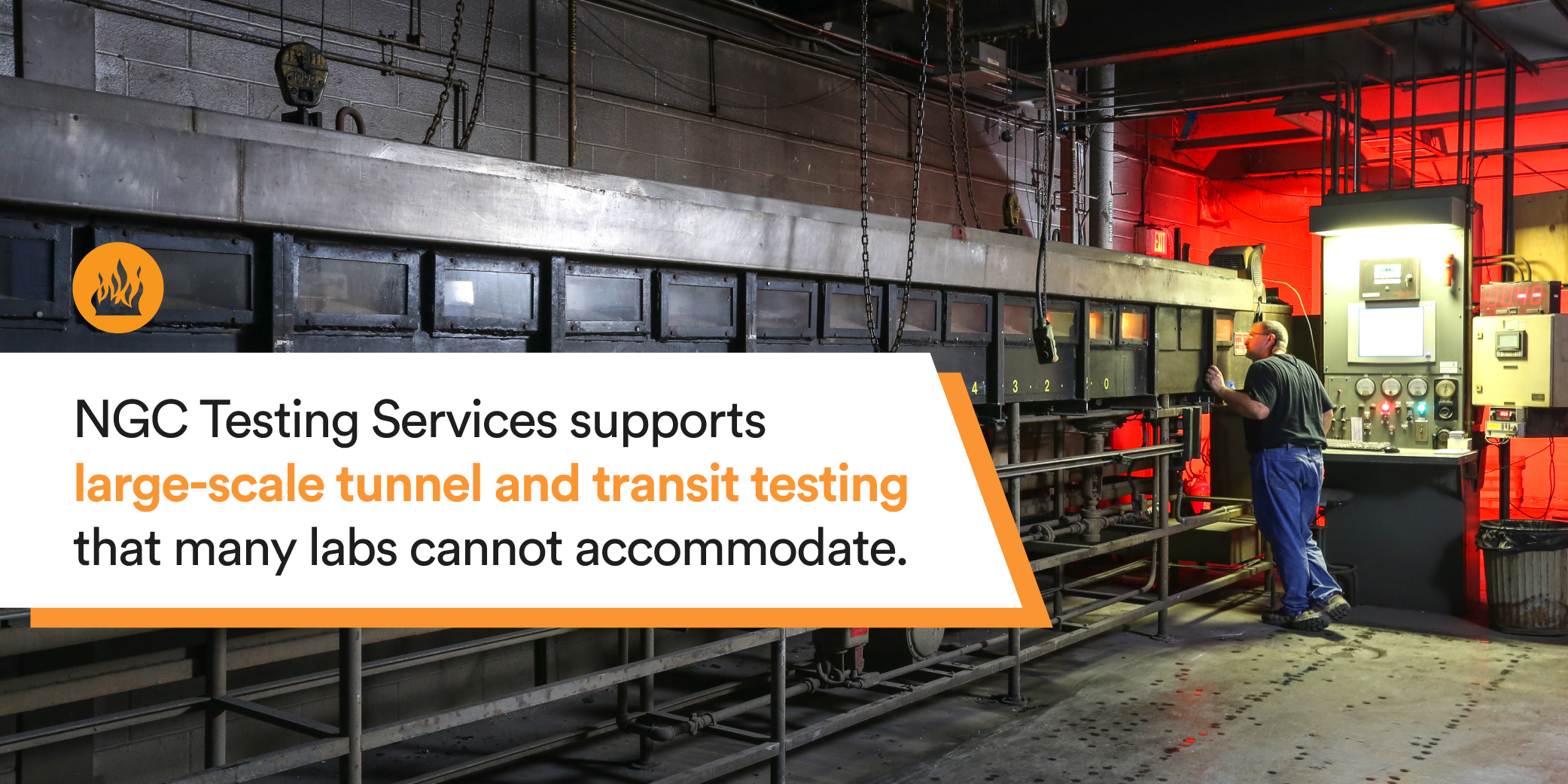
Our facility features oversized doors, overhead cranes, and a horizontal ASTM E119 fire-resistance chamber. That scale lets our specialists run large-sample and full-assembly tests that small-scale methods cannot match.
These large-scale capabilities are especially valuable when manufacturers and engineers engage fire testing early in the product development process.
Early evaluation helps identify potential performance risks before final design and installation, while testing materials at realistic thicknesses and in representative mounting orientations improves confidence in the results.
Where applicable, we also combine ASTM E84 with complementary tests, such as ASTM E1354, ASTM E119, or NFPA 130. Together, they give transit authorities, AHJs, and design teams more complete documentation.
What’s Next for Tunnel Fire Testing
As tunnel and transit construction expands, fire testing continues to adapt to the demands of underground environments. Standards and testing methods are evolving to better reflect how materials perform in confined, high-traffic spaces where smoke control and evacuation are critical.
The goal is consistent, reliable evaluation of the materials and systems used in tunnel and transit environments, so manufacturers and project teams can move forward with confidence.
The continued growth of large-scale infrastructure and evolving construction practices is placing new demands on fire testing standards. While ASTM E84 remains a valuable tool for evaluating surface burning characteristics, ongoing refinement is necessary to keep pace with evolving materials, assemblies, and installation methods.
NGC Testing Services actively supports these efforts by participating in a consensus-driven process that helps advance fire testing practices and improve infrastructure safety.
To learn more about our testing services, contact our team today.