
When it comes to building materials and acoustical performance, two critical properties immediately come into focus: sound absorption and sound transmission.
Sound absorption refers to a building material’s ability to soak up sound energy and reduce echo or reverberation within a space, while sound transmission describes how well that material blocks sound from passing through it.
Accurate measurement of these properties is essential not only for meeting building codes and certification requirements, but also to ensure that the product performs as expected when it’s being used out in the real world.
At the heart of this testing lies the reverberation chamber, the industry-standard tool used to quantify sound absorption and transmission. Every acoustical product, whether a wall panel, insulation material, or glazing system, tells its story through sound, and that same story begins inside a reverberation chamber.
What Is a Reverberation Chamber?
A reverberation chamber, also known as a reverberant chamber, is a specially designed room constructed with hard, reflective surfaces and irregular geometry. These features work together to create a diffused sound field where sound waves reflect repeatedly and uniformly throughout the space.
The chamber’s size is also carefully chosen to minimize standing waves, as well as provide an environment that simulates the complex acoustic behavior found in real-world settings where energy is reflected repeatedly.
Both the design and operation of a reverberation chamber are governed by strict standards, such as ASTM C423 for sound absorption, ASTM E90 for sound transmission, as well as international standards such as ISO 354 and ISO 10140.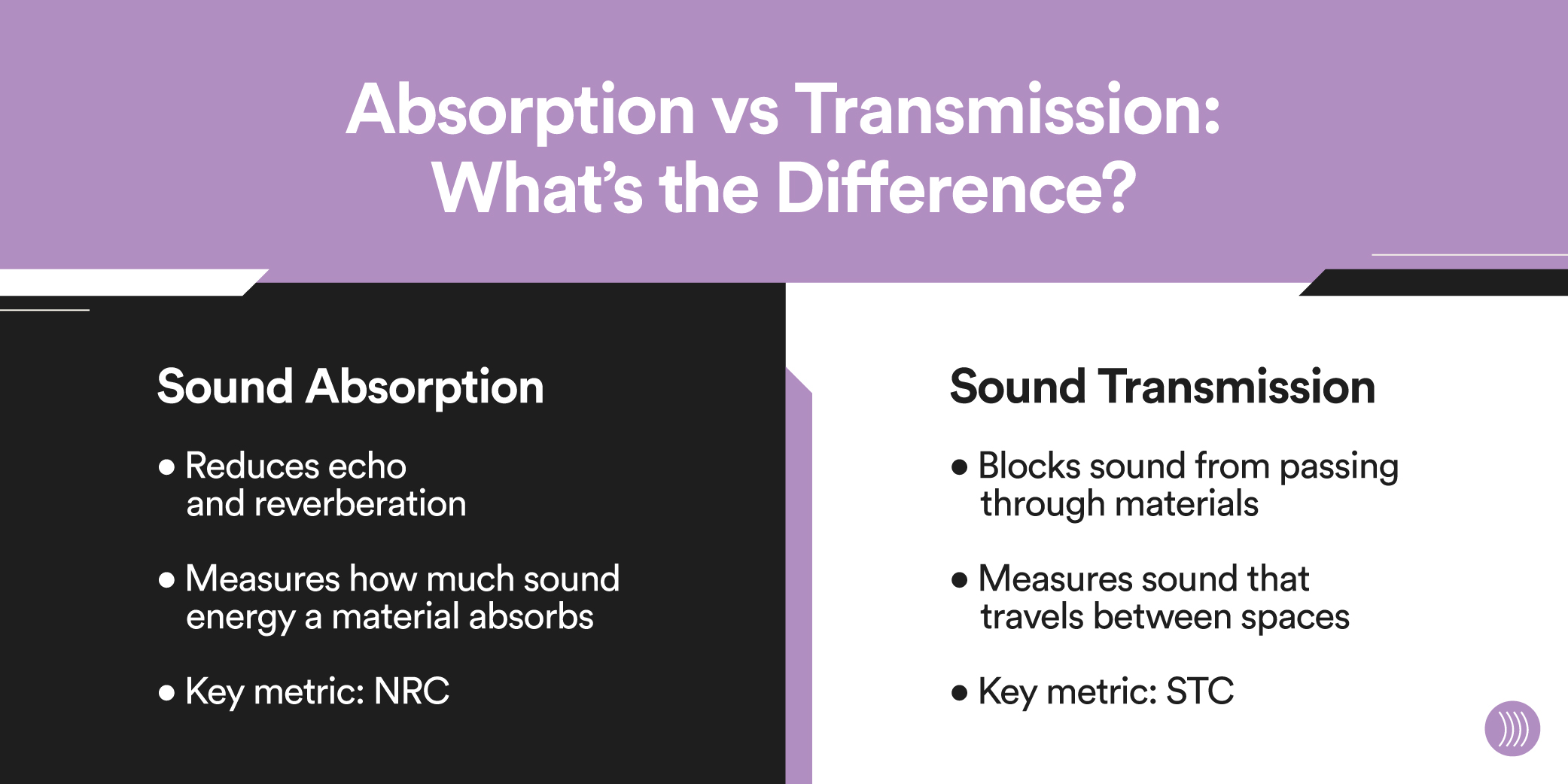
All of these standards help to ensure consistent and repeatable testing results across different laboratories and product types.
How Reverberation Chambers Measure Sound Absorption
Sound absorption is measured by comparing the reverberation time of the empty acoustic reverberation chamber versus when the chamber contains the test material. This is referred to as RT60, which is defined as the time it takes for sound energy to decay by 60 decibels from its initial level.
A shorter reverberation time will indicate that the material absorbs more sound energy, reducing reflections and echoes. Longer reverberation time means the material absorbs less sound energy.
By quantifying the difference in RT60 both before and after installing a sample, the absorption performance can be accurately calculated during testing.
The Sound Absorption Testing Process
- First, measure the baseline reverberation time of the chamber while it is still empty.
- Then, install the material sample inside the chamber, typically on walls or ceiling panels.
- Measure the new reverberation time with the sample securely in place.
- Now, calculate the absorption coefficients based on the change in RT60, producing values such as the Sound Absorption Coefficient and Noise Reduction Coefficient.
What the Results Show
The Sound Absorption Coefficient (α) represents the fraction of sound energy absorbed by the material at specific frequencies, ranging from 0 (no absorption) to 1 (complete absorption).
The Noise Reduction Coefficient (NRC) is a single-number rating derived from the average absorption coefficients at several different frequencies. This is commonly used by manufacturers who need to communicate the overall sound absorption performance of a product.
Both of these results are essential in helping architects, engineers, and manufacturers demonstrate product compliance while simultaneously optimizing the acoustical design of their ceiling tiles, wall panels, insulation, or other building products.
How Reverberation Chambers Measure Sound Transmission
Sound Transmission Class (STC) ratings quantify a wall’s ability to block airborne sound. To measure this, two reverberation chambers must be used at the same time.
One is referred to as the source room, where broadband noise is generated. The second is known as the receiving room, where transmitted sound through the test specimen is measured.
The Sound Transmission Testing Process
ASTM E90 clearly outlines the steps you must follow during reverberation chamber testing:
- First, place the partition or assembly between two separate reverberation chambers.
- Start generating broadband noise in the source chamber.
- Then, measure the sound pressure levels in both chambers across frequencies.
- Be sure to account for reverberation time and background noise in these calculations.
- Once the testing has concluded, you can then calculate Transmission Loss (TL) and derive the STC rating.
Why Reverberation Matters in Transmission Testing
The diffuse and uniform sound field that is created within these reverberation chambers also ensures that the test results are repeatable and accurately represent testing conditions.
This standardization can minimize variability between labs and other testing sessions, so every test outcome can confidently deliver reliable, comparable results that are critical when used for certification and product specification on the market.
Advantages of Reverberation Chamber Testing
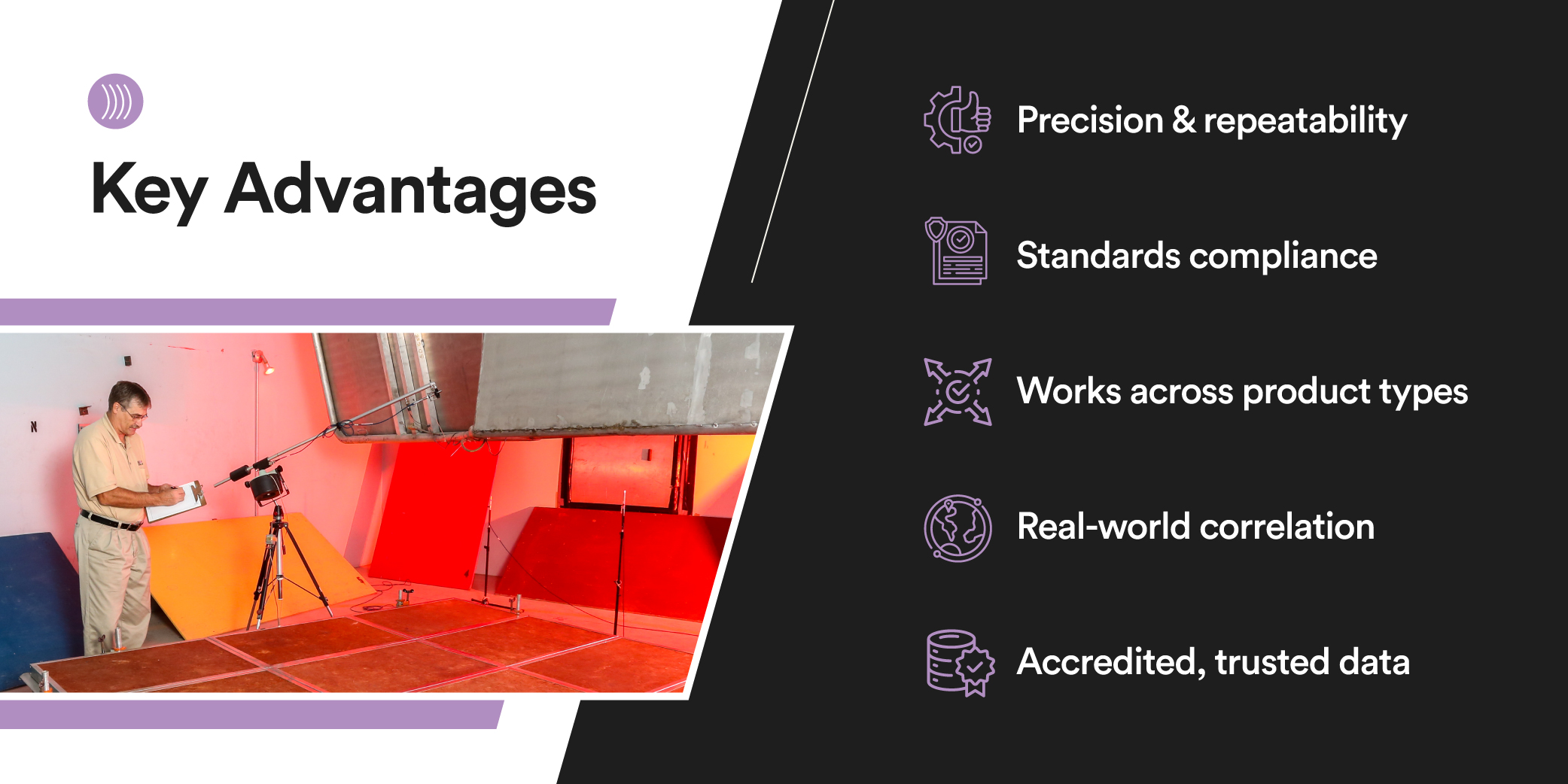
Whether you’re comparing design options, validating performance claims, or preparing for certification, reverberation chamber testing gives you the reliable data you need to make confident decisions. Benefits include:
- Precision and repeatability: A controlled environment minimizes potential uncertainty and provides consistent results regardless of where the test is being conducted.
- Compliance with standards: Reverberation chamber testing is required for recognized acoustical ratings like STC and NRC.
- Versatility: This level of testing is suitable for a wide range of products, including walls, floors, glazing, doors, and insulation.
- Real-world correlation: Reverberation chamber testing simulates diffused sound fields similar to those found in buildings and construction environments, which is where these products will one day end up in use.
- Accreditation confidence: Results from accredited labs, such as NGC Testing Services, are known and trusted for certification, marketing claims, and regulatory compliance.
Common Challenges and Considerations
Accurate reverberation chamber testing always depends on careful attention to several factors, including:
- Sample size and preparation: Proper installation, mounting, and sealing of the product samples within the chamber are critical to avoid measurement errors or false test results.
- Edge effects: In situations where there is inadequate sealing or improper edge conditions, it can easily skew transmission loss results.
- Frequency range: Absorption and transmission can vary significantly across frequency bands, which is why it’s crucial to understand which bands matter for your product.
- Interpretation: Lab results may differ from field performance due to installation variables and real-world conditions, making expert interpretation essential.
Why Choose an Accredited Lab Like NGC Testing Services
NGC Testing Services delivers comprehensive reverberation chamber testing for both sound absorption and sound transmission, grounded in decades of expertise and strict compliance with international standards.
We are ISO/IEC 17025 and NVLAP accredited, and our team provides expert guidance in interpreting test data and ensuring every test aligns with your certification, compliance, or product development goals from the start.
Because we offer a full suite of analytical, physical, acoustic, fire, and structural tests, we streamline your testing program by coordinating multiple evaluations under one roof. The result: faster timelines, smoother workflows, and greater efficiency.
Final Thoughts
Partnering early with an accredited lab like NGC Testing Services ensures accurate, efficient, and compliant acoustical testing that supports successful product launches and certifications.
Reverberation chamber testing forms the foundation of dependable acoustical performance data, delivering precise measurements of sound absorption and transmission for building materials.
By leveraging a controlled, accredited testing environment, manufacturers and designers can confidently validate product performance, meet regulatory requirements, and move forward without unnecessary hurdles.
Ready to verify your product’s acoustical performance? Contact NGC Testing Services to schedule your next absorption or transmission test.