
In the ever-evolving landscape of building construction, ensuring the highest standards of fire safety is non-negotiable. Among the various benchmarks that contribute to this crucial aspect, NFPA 285 stands out as a pivotal guideline designed to assess the fire performance of exterior wall assemblies.
As you navigate the complexities of constructing safe and compliant buildings, understanding the nuances of NFPA 285 becomes paramount.
This blog aims to unravel the intricacies surrounding NFPA 285 pass/fail criteria, explore its applications, and shed light on the profound implications for building design and construction.
What Is NFPA 285?
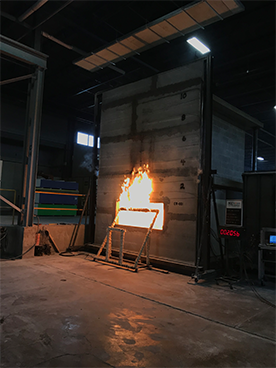 NFPA 285 is a standard from the National Fire Protection Association (NFPA). It provides a test method for determining the flammability characteristics of exterior, non-load-bearing wall assemblies that contain combustible components as part of the construction.
The NFPA 285 standard fire test method utilizes a large two-story fire test apparatus with gas burners in the lower-story room and adjacent to a lower-story window opening.
The performance of the exterior wall is determined on the basis of visual observations both during and after the test, in conjunction with the temperature data recorded during the fire test. The exterior wall is considered to pass when the performance criteria specified below are met during the 30-minute fire exposure.
When Is NFPA 285 Required?
You must comply with NFPA 285 requirements under certain conditions in the International Building Code (IBC). In general, NFPA 285 testing is triggered when:
- An exterior wall assembly includes combustible materials such as foam plastic insulation or combustible cladding.
- The building is Type I, II, III, or IV construction and more than 40 feet in height.
- Designers seek approval for alternative wall assemblies not specifically listed as code-compliant.
In other words, if your design includes combustible components in the wall assembly, there’s a strong chance NFPA 285 testing will be required. Always consult the latest edition of the IBC to confirm whether NFPA 285 compliance applies to your project.
Testing Procedure Outlined in NFPA 285
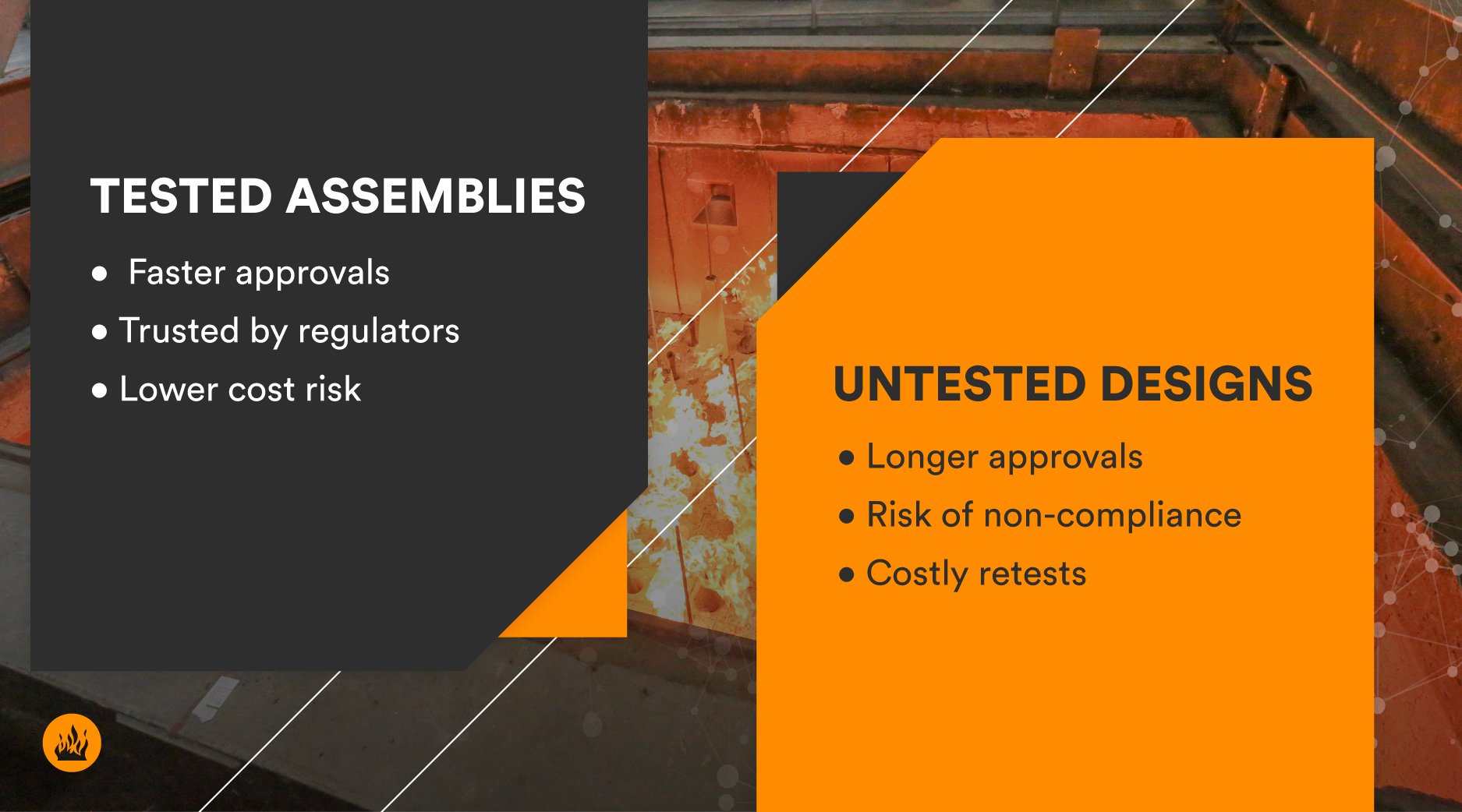
Here’s an overview of the fire testing procedure as outlined in NFPA 285:
- The testing process begins with the selection of a specific wall assembly configuration that represents the intended construction. This includes choices for insulation materials, cladding systems, and other components.
- Full-scale test specimens are fabricated based on the chosen wall assembly configuration. These specimens must accurately replicate the materials and construction methods intended for use in the actual building.
- The wall assembly being tested is instrumented with sensors to measure critical parameters during the fire test. This includes monitoring temperature, burner gas flow, and other relevant data points.
- The test specimens are then exposed to a controlled fire source, simulating a fire scenario that could occur in real-world conditions.
- Throughout the test, continuous monitoring allows for the collection of information on factors such as flame propagation, temperature changes, and the behavior of different components in the wall assembly.
- The collected data is analyzed to determine whether the tested wall assembly meets the pass criteria outlined in NFPA 285. The analysis includes a comprehensive evaluation of the assembly’s response to fire exposure.
- A detailed report is generated, documenting the entire testing process, including the chosen wall assembly configuration, test conditions, instrumentation details, and observed results. This report serves as a crucial record for compliance verification and future reference.
- If the wall assembly fails to meet the pass criteria, modifications may be made, and the testing process may be repeated iteratively until compliance is achieved.
NFPA 285 testing is a rigorous process that aims to ensure the fire safety of exterior wall assemblies. Professionals involved in building design and construction must adhere to the standard’s guidelines and work with accredited testing facilities to accurately assess the fire propagation characteristics of their intended wall assemblies.
Components of NFPA 285 Pass/Fail Criteria
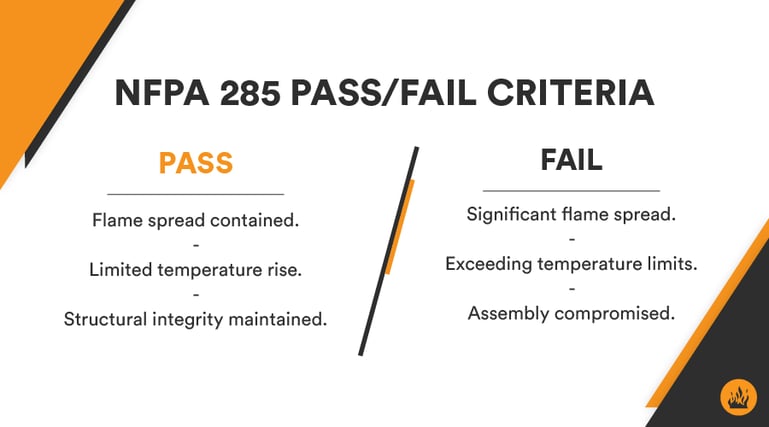
Vertical or Horizontal Flame Propagation: Exterior Face of Test Specimen
Flame propagation on the exterior face of the test wall shall not occur either vertically or horizontally beyond the area of flame plume impingement by the window burner flames. Flame propagation shall be determined to occur if any one of the following conditions is measured or observed:
- A temperature of 1000℉ (538℃) is measured by any one of the specific exterior face thermocouples.
- Flames emitting from the surface of the exterior face of the test wall reach a height of 10 ft (3.05 m) or greater above the top of the window opening.
- Flames emitting from the surface of the exterior face of the test wall reach a horizontal distance of 5 ft (1.52 m) or greater from the vertical centerline of the window opening.
Vertical or Horizontal Flame Propagation: Combustible Components and Insulation
Flame propagation shall not occur either vertically or horizontally through the wall cavity air space combustible components or the combustible insulation installed within the test specimen, as determined by temperatures measured by specific test wall thermocouples.
Temperatures in Second-Story Test Room
Temperatures measured 1 in (25 mm) from the interior surface of the test specimen within the second-story test room shall not exceed 500℉ (278°C) above the ambient air temperature at the start of the fire test.
Flames in Second-Story Test Room
Flames shall not occur in the second-story test room.
Flame Propagation to Adjacent Horizontal Spaces
Flames shall not occur beyond the intersection of the test wall and the sidewalls of the test apparatus.
Frequently Asked Questions About NFPA 285 Fire Testing
Why is NFPA 285 testing important for building design?
NFPA 285 testing ensures that exterior wall assemblies containing combustible components won’t allow dangerous flame spread. For architects and engineers, this is critical for both life safety and IBC code compliance.
Are individual products “NFPA 285 approved”?
No. Only entire wall assemblies can be tested and approved under NFPA 285.
What happens if my wall assembly fails NFPA 285 testing?
If an assembly fails, modifications are needed, such as adjusting insulation type, thickness, or cladding materials. Partnering with an experienced lab early can help reduce the risk of failure and retesting costs.
What documentation do I need for NFPA 285 testing?
You’ll need detailed wall assembly drawings, a list of all components and manufacturers, and material samples in good condition. Accredited labs also provide a test plan and reporting format aligned with ISO 17025 standards.
How long does it take to get NFPA 285 test results?
While some labs take months, NGC Testing Services can typically complete NFPA 285 testing and provide results in weeks, depending on project scope and scheduling.
Navigate NFPA 285 Compliance With Confidence
NFPA 285 testing is a complex process, and engaging with experienced professionals and accredited testing facilities is essential to ensure accurate and reliable results.
NGC Testing Services offers a wide range of full-scale fire tests, including NFPA 285. Let us know if we can answer any additional questions or provide assistance in your future testing needs.
Contact us now to get in touch with our team of experts.

This post was originally published in September 2021 by Bob Menchetti and was updated and republished in November 2023 and again in October 2025.